
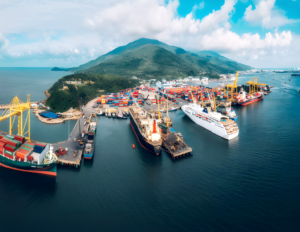
Supply–Demand Imbalance Adds Further Pressure on Global Ocean Freight Rates in 2026
The supply–demand imbalance in the maritime transport sector in 2026 is emerging as a major factor exerting downward pressure on global ocean freight rates, as weakening demand coincides with continued growth in fleet capacity.
According to Drewry, a London-based maritime consultancy, the total volume of containers handled at ports worldwide in 2025 increased by 5.5% compared with 2024, despite U.S. reciprocal tariffs, ongoing supply chain disruptions, and the prolonged crisis in the Red Sea.
Container Volumes Boosted by Early Import Activity
Throughout 2025, U.S. importers repeatedly accelerated shipments to “front-run” potential tariffs introduced by President Donald Trump. In addition, cargo volumes were supported by a U.S.–China trade “truce” reached in late October.
However, Simon Heaney, Senior Manager of Container Research at Drewry, noted that the stronger-than-expected annual volume growth was largely inflated by early ordering and inventory stockpiling, rather than reflecting genuine underlying transport demand.
Muted Outlook for Global Shipping in 2026
Heaney said the outlook for the global maritime transport market in 2026 is tilting toward the downside, driven by heightened geopolitical risks, slower global economic growth, and weakening real demand for container shipping.
Drewry forecasts that global container throughput will increase by only 1.8% in 2026. Significantly lower than the growth recorded in the previous year.
Excess Fleet Capacity Weighs on Freight Rates
While demand growth is slowing, global shipping capacity continues to expand. Drewry estimates that current newbuilding orders stand at approximately 11 million TEU. Equivalent to nearly one-third of the existing global container fleet.
This oversupply of capacity is expected to exert long-term downward pressure on ocean freight rates. According to Drewry, average freight rates are projected to decline by 17% this year, following an 18% drop in 2025.
Red Sea and Suez Canal Routes May Further Depress Rates
The resumption of shipping routes through the Red Sea and the Suez Canal is also seen as a factor that could further reduce ocean freight rates. Maersk has announced plans to restart services through the region later this month for routes linking India and the Middle East with the U.S. East Coast.
Parash Jain, Global Head of Transport and Logistics Research at HSBC. Noted that detours to avoid Red Sea tensions previously absorbed around 7%–8% of global container vessel capacity. If shorter routes are restored, spot freight rates could fall sharply, adding further pressure on trans-Pacific shipping contracts in 2026.