

China aims to complete mega canal project linking to its largest export market
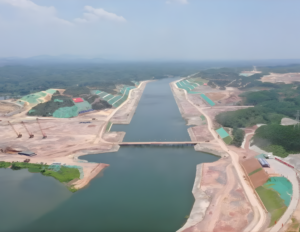
China is nearing completion of the $10 billion Pinglu Canal, designed to strengthen trade between its southwestern provinces and Southeast Asia. However, the world’s second-largest economy is already planning an even more ambitious project — the Xianggui Canal — with significantly larger scale and cost.
Xianggui Canal – a strategic extension of Pinglu
The Xianggui Canal stretches approximately 300 km and is designed as an extension of the Pinglu Canal. This inland waterway will allow cities deep inside China to connect directly to the Gulf of Tonkin.
The project’s primary goal is to shorten transportation time and enable inland goods to access global maritime shipping routes more efficiently.
Direct connection to the ASEAN export market
Like its predecessor, the Xianggui Canal aims to improve access for inland Chinese cities to the country’s largest export market: ASEAN.
Direct inland waterway connectivity will help:
-
Optimize logistics costs
-
Shorten supply chains
-
Enhance export competitiveness
Formation of the 3,200-km Han-Xiang-Gui transport corridor
Once completed, the canal will form part of a vast inland water transport network known as the Han-Xiang-Gui Corridor.
The corridor will span 3,200 km from north to south, crossing four provinces:
-
Shaanxi
-
Hubei
-
Hunan
-
Guangxi
This network will create a vital inland-to-sea transport artery.
Investment cost reaches $21.6 billion
The Xianggui Canal project is estimated to cost 150 billion yuan (US$21.6 billion). More than double the investment of the Pinglu Canal.
The massive capital requirement highlights China’s long-term ambition to expand inland waterway logistics infrastructure.
Proposal submitted for the 2026–2030 national development plan
Authorities in Hunan Province have submitted a proposal to include the project in China’s 2026–2030 National Development Plan.
If approved in the final blueprint — expected to be released in March 2026 — the Xianggui Canal will be officially greenlit for construction.
Meanwhile, Hubei Province has incorporated sections of the Han-Xiang-Gui Corridor into its next five-year plan, alongside a major project to expand shipping capacity at the Three Gorges Dam.
Integrating national river and canal networks
According to Professor Lu Yi of Changsha University of Science and Technology. The corridor is part of a plan announced by Beijing in 2021 to integrate major rivers and canals. Into a high-capacity national transport network.
Once completed, the four provinces will not only share a logistics lifeline but also gain a crucial southern gateway to the sea.
Upgrading Han River shipping infrastructure
Since 2024, Hubei Province has been upgrading ship locks and waterways along the Han River.
The goal is to allow vessels of up to 2,000 tons to navigate the river.
Boosting inland economies and industrial relocation
Economists say expanding inland waterway transport could:
-
Stimulate central and western regional economies
-
Support industrial relocation from coastal areas
-
Reduce supply chain pressure
As factories move inland, demand for low-cost logistics continues to grow.
Attracting industrial clusters and elevating Pinglu’s strategic role
Beyond lowering logistics costs, inland waterways can help attract new industrial clusters.
Yu Jiaxiang, an expert from Hubei Port Group. Said the Han-Xiang-Gui Corridor will further enhance the strategic influence of the Pinglu Canal — especially as China accelerates industrial relocation into inland regions.